
Read Minidoka County Property Tax Records
Two offices split the record. The Assessor builds the value side. That means the parcel description, ownership roll, market-value assessment, exemptions, and appraisal history for Minidoka County property. The Treasurer owns billing. Bills, payments, delinquencies, and special assessments sit with the Treasurer and Tax Collector, though the county GIS schema can display both sets of clues in one popup, leaving each office the authority for its own fields.
| Tax record field | Meaning | Official source |
|---|---|---|
| Last assessed value | The roll value shown as LastAsmVal in the GIS schema | Minidoka County Assessor |
| Homeowner exemption | The exemption amount represented by HOExemptVa | Assessor and Idaho Tax Commission |
| Current and prior tax | Bill, amount owed, payments, and penalties configured in county GIS fields | Treasurer / Tax Collector |
| Tax-code area | The district combination that helps explain the levy applied to a parcel | Assessor GIS and Treasurer |
| Last sale value and date | A separate history clue, not the current assessment | GIS schema, then Recorder verification |
Idaho requires assessment at market value. That number, a sale figure, and the amount due are three different things. The bill adds exemptions and the parcel's taxing districts on top. The value fields have their own meanings. For those, without the bill mechanics, see the Minidoka County property value guide.
Minidoka County's Five-Year Appraisal Cycle
The Real Property Assessments page says property is assessed continuously. At least 20 percent of county property enters the appraisal program each year, producing a full appraisal within five years. Annual indexing uses sales and inspections between full appraisals, and the Assessor retains the last appraisal record.
The assessment roll is completed by the fourth Monday in June under Idaho Code §63-310. That snapshot explains why a recent transfer or improvement may not align at once with every visible field. It does not establish a fixed lag in days, because Minidoka County has not published one.
The official assessment explanation captured for this project shows the county's market-value standard and cycle:
View the Minidoka County assessment source.

Put the policy page to practical use when reading a year on the roll. Then ask the Assessor which appraisal or index action produced a particular parcel value.
Search Minidoka County Tax Fields in the Parcel Viewer
For most people, the address-to-parcel route runs through the public Minidoka County Parcel Viewer. Its public configuration supports property-address, parcel-number, and owner searches, though anonymous feature queries are blocked. The tax fields below come from the popup schema rather than a live sample bill.
| Configured field | Record clue | How to use it |
|---|---|---|
CurTxBillN, CurTxBille | Current bill identifiers or amounts | Confirm the live balance with Treasurer |
CurTxOwed, TotTxOwed | Current and total tax owed | Treat as a portal clue, not a payoff quote |
PrevTxBill, PrevTxPena | Prior bill and penalty fields | Check the applicable tax year |
PrevTxPaym, PrvTxOwed | Prior payment and balance fields | Reconcile with Treasurer records |
The county publishes no separate public assessor card and no full tax-account field list for inspection. The parcel viewer in the GIS map is still the practical starting point for Minidoka County property records. When a live search does not return a parcel, write down the address and APN and call the property division at 208-436-7181 Option 2 for help pulling the parcel record.
Note: A configured GIS field shows that the map can display that attribute, not that the displayed amount is a certified payoff.
Look Up a Minidoka County Tax Bill
Start with the parcel number, not the address. A mailing address and a situs address are not always the same thing, and the parcel key gives the Treasurer an exact record to pull. From there, move to the official payment channel. The Point & Pay portal walks users through a three-stage payment workflow, though its accessible page does not lay out every property-account field it holds.
- Find the property in the county parcel viewer and copy the exact parcel ID.
- Open Point & Pay, select the payment, and review it before submitting.
- Compare the tax year, current amount, prior amount, and exemption field with the assessment record.
- Ask the Treasurer about any delinquency, late charge, interest, or special assessment before relying on a balance.
- Assessed value
- The Assessor's value before the bill calculation and applicable exemptions are reconciled.
- Levy
- The rate produced by taxing-district budgets and the taxable value base.
- Homeowner exemption
- State-authorized relief applied through the county Assessor when eligibility rules are met.
- Tax lien
- The county's claim arising from unpaid property taxes, distinct from a mortgage or judgment lien.
The portal's path is Select Payments, then Review and Submit, then Confirmation and Receipt. Each stage confirms one step of a Minidoka County property tax payment before the next appears.
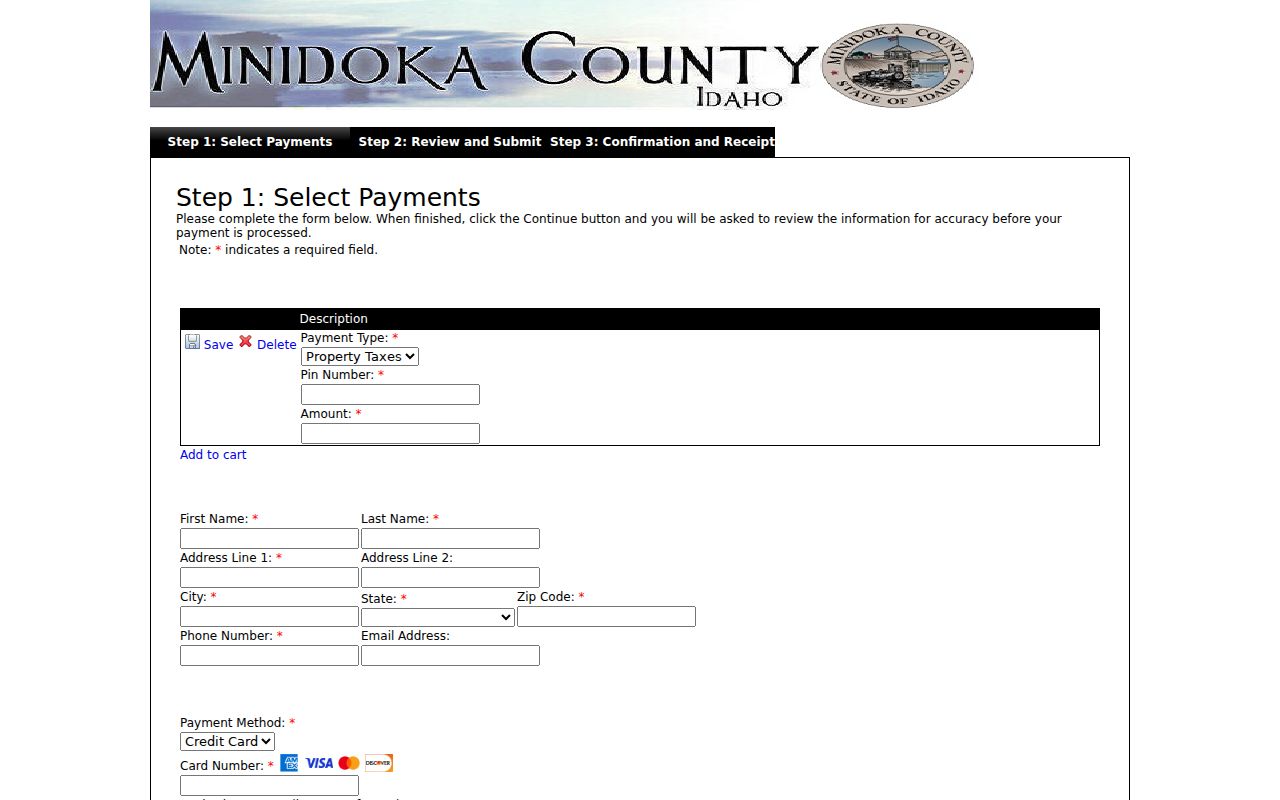
A receipt proves that single portal transaction. It does not stand in for a Treasurer statement covering every outstanding year or charge on the parcel.
Minidoka County Property Tax Due Dates and Delinquency
The county real-property tax guidance sets the deadlines. The first half of a Minidoka County tax bill is due December 20, and the second half is due June 20. Miss a half and the parcel draws a 2 percent late charge plus 1 percent monthly interest under the county's published rules. Partial payments are accepted. Still, the full total must land by the due date to keep the account out of delinquency.
Mail timing carries an unusual wrinkle. A post-office cancellation date counts as the filing date, while a postage-meter date does not. A notice that never arrives does not erase the charges either. The Treasurer at 715 G Street in Rupert can reconcile mailed payments, old balances, and special assessments tied to the tax roll.
The Treasurer also serves as ex officio Tax Collector and collects far more than the ordinary real-property levy. Published duties include personal-property taxes, harvested-timber taxes, and special assessments for services such as water, fire, local improvements, and translators. That is why the parcel's base appraisal alone cannot reproduce the final amount on every Minidoka County tax bill.
When you request a payment history, name the tax year and ask how each payment was applied. County guidance states that a delinquent payment is distributed proportionally among costs, interest, late charges, and delinquent tax under Idaho Code §63-1002. So one payment entry cannot be assumed to have cleared the oldest principal first.
Minidoka County Exemptions and Tax Relief
Owners in Minidoka County can turn to the county's Property Tax Relief page for homeowner exemptions, hardship cancellation, casualty-loss relief, and payment extensions. The details live there. Eligibility rules and dollar amounts shift from year to year, so always file with the current application rather than trusting a prior-year summary or an old figure pulled from property records.
The county's GIS data adds a useful clue. The schema includes HOExemptVa, a field that helps explain why an assessor's assessed value and the taxable value on a tax bill part ways. Treat it as a display hint, though. It does not decide eligibility. For the application itself, contact the Assessor; for how approved relief shows up on a tax bill, ask the Treasurer.

Exemption amounts and filing rules are set at the state level and can change, so the published forms and deadlines are the authoritative reference. Checking them each year keeps a Minidoka County exemption application on schedule.
Why Minidoka County Tax-Code Areas Differ
Two Minidoka County parcels can sit side by side and still carry very different tax bills. Their assessed values may nearly match. The difference comes from districts. The county GIS layers map school, fire, flood, sewer and water, library, cemetery, hospital, highway, urban renewal, and other taxing areas. A TaxCdArea field ties each parcel to its code area. Those boundaries show which public budgets touch a given parcel.
Still, a map layer is only context. The Treasurer's roll controls the billed charges. District lines will not reveal an easement or any private encumbrance on the parcel. For map geometry and controls, see the Minidoka County parcel map guide.
Historic Minidoka County Tax-Deed Notices
Minidoka County's current Tax Deed Auctions page reports no auctions at this time. The county document center retains older notices. Keep those two facts separate. A dated notice is a sale record. The 2020 notice, for example, listed an APN, situs address, and legal description. It also named the former owner of record, delinquent amount, costs, and opening bid. None of that is current inventory.
Older notices still serve a purpose. They help trace a Minidoka County parcel through distressed-property records. They do not guarantee clear title. The final word comes from the recorded tax deed or redemption record at the Recorder. Avoid the common myth. An auction notice alone never proves who ended up owning the parcel.
The archived examples show what the record inventory looks like. One Rupert parcel is listed as RPR18900550080, situs 529 5th Street. It covers Lot 8, Block 55 of the Townsite of Rupert. A Heyburn example uses RPH23000020060, Lot 6, Block 2 of Imperial Estates. Copy such APNs exactly. Do not reverse-engineer the prefixes, since the Assessor publishes no prefix dictionary.
Contest a Minidoka County Property Assessment
Begin with the Minidoka County Assessor. Ask which property facts, sales, inspection, or index factor produced the value. Verify the parcel identity first: acreage, legal description, improvement area, and exemption status. Only then argue about price. If the dispute remains, take the formal appeal further. The county clerk and Board of Equalization handle it during the statutory roll period.
Idaho ties the appeal to the June roll. The Board sits through the second Monday in July. Confirm the filing cutoff and the required form with the county itself. A general state explanation cannot extend a local deadline. Strong evidence speaks to value on the assessment date. A claim that the tax simply feels high goes nowhere.
Keep dated copies of every notice and every piece of evidence submitted.
Appeal window. Contact the Minidoka County Clerk and Assessor as soon as the June assessment notice arrives; the statutory Board of Equalization schedule is short.