
Trace Minidoka County Former Owners Transfer by Transfer
Start with the newest confirmed deed. Build the backward timeline from there. The Recorder files deeds, grants, transfers, mortgages, releases, leases, judgments affecting title, liens, water-right instruments, and probate wills admitted to probate. Each transfer hands you the next name to search. The rows below are a working sheet for any Minidoka County parcel, not a record of one real property.
| Transfer date | Grantor → grantee | Instrument | Reference to save |
|---|---|---|---|
| Newest recorded date | Seller → present grantee | Warranty, quitclaim, or other deed | Instrument number and legal description |
| Prior recorded date | Earlier seller → later seller | Acquisition deed | Book/page or image reference |
| Earlier book entry | Prior grantor → prior grantee | Deed, patent, or estate transfer | Volume, page, lot/block, or land description |
A tax-sale or court notice is not proof of past ownership. It is a dated lead, nothing more. The recorded instrument that created or ended the interest is what belongs in the timeline. A county auction notice can preserve parcel IDs, names, legal descriptions, and bids. It still warns that it guarantees no clear title.
The Minidoka County Online Index Has a Hard Limit
The Recorder's Recorded Land Records page routes searchers to Tyler public access. Minidoka County warns that its index is incomplete. A result set stops at the 1,000 most recent recorded documents. No first online year appears. A broad surname search can therefore bury the one deed. That deed may identify previous owners of a Minidoka County parcel.
Coverage alert. The online start year is not published; ask the Recorder for older deed books, images, and index help.
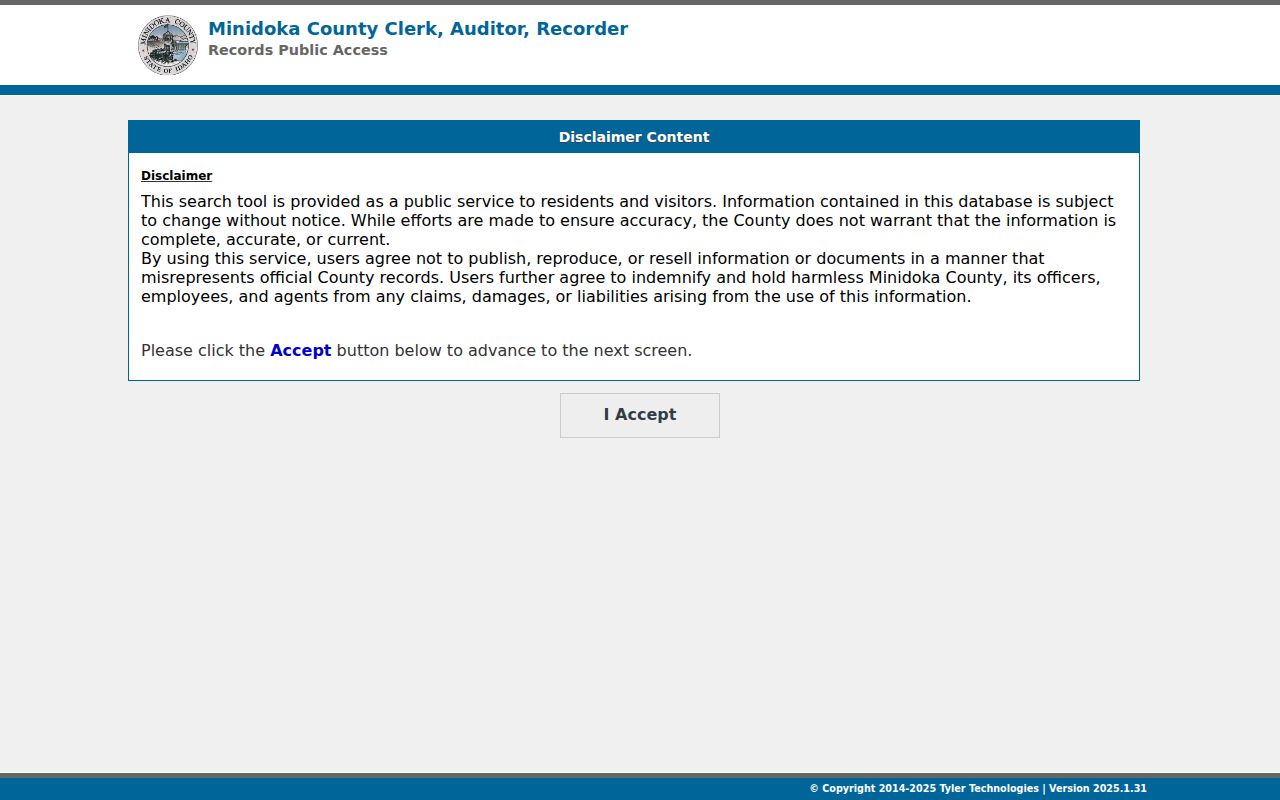
The captured official Tyler page shows the disclaimer and login-gated search state.
The instrument number matters most at that point. When a surname returns too much, or a deed image will not load, the Recorder counter can retrieve the document by number.
Legal Descriptions Hold Minidoka Prior Owners Together
Family names change with every transfer. Street addresses arrive late. A rural Minidoka County lot may gain its situs address decades after the first deed. So carry the legal description at every step. Rupert deeds often rely on townsite lot and block terms. Heyburn records may add Second State Addition or a named phase. Paul-area instruments can use township, range, section, quarter-quarter, railroad, tax-lot, irrigation, or government-lot clauses.
The county parcel viewer lists parcel ID, situs, legal description, and five deed-reference fields. Those fields are aids, not answers. Save the exact parcel number and full description. Then compare both against each deed the Recorder holds. Treat every deed slot as a lead.
The GIS separates the owner mailing address from the situs. That is why an unfamiliar city can sit beside an owner's name while the parcel stays put. Prior-sale dates and values only suggest a window. None of it enters the timeline until the Recorder confirms the deed reference matches the same Minidoka County legal tract. Its recorded creation, assignments, and releases are checked in turn.
Walk the Minidoka County Deed Chain Backward
Work from a confirmed recent transfer. Each grantor seeds the next grantee search. Keep a log, because spouses, trusts, estates, and spelling variants can branch a Minidoka County deed chain faster than any single search can resolve.
- Find the present owner's acquisition deed, with that owner shown as grantee.
- Copy the grantor name, recording date, instrument number, deed type, and legal description.
- Search that grantor as an earlier grantee, then compare the land description before accepting a match.
- Repeat until online coverage ends, then continue through Recorder indexes and deed books.
- Grantor / grantee
- The party conveying an interest and the party receiving it.
- Chain of title
- The linked sequence of recorded transfers for the same land.
- Reverse index
- An index used to approach instruments from the grantor side.
- Warranty / quitclaim deed
- Different conveyance forms; the label alone does not prove the state of title.
The 1913 to 1961 Minidoka Collection Extends the Search
FamilySearch catalogs an Idaho, Minidoka County Records, 1913-1961 collection. Deeds sit beside probate, marriage, naturalization, military, patent, and school-census material. That mix matters when an estate, heir, patent, or changed surname interrupts a clean deed series. Access may require a login or a FamilySearch center. It is an index, not a modern Recorder substitute.
Save the catalog reference. Then ask the Recorder or the Idaho State Archives whether the matching official volume holds the deed image you need.
Rupert's Early Townsite Points Beyond Present Minidoka County
Rupert was platted in 1905. Incorporation followed in 1906. The townsite plat itself was filed in Lincoln County in 1907, so searching only the present county name can miss that early place-context clue. Combine Rupert, Original Townsite, lot, block, and Lincoln County. Verify the instrument in official records. Old Rupert descriptions lean on the official plat, while newer rural-edge records may use government lots, tax parcels, sections, townships, and ranges, and that shift in wording tells you which map or index comes next.
Estates and Liens Can Break a Minidoka Owner Chain
Not every ownership change is a sale. The Clerk and Recorder also hold probate wills admitted to probate, judgments and decrees affecting title or possession, liens, releases, and lis pendens. An estate may pass land through a representative's deed. A court order may explain why names refuse to line up.
Search the decedent, estate, trustee, and representative names. Keep the same legal description throughout. Idaho iCourt may offer a case lead, but full files stay with the clerk, and access follows Idaho Court Administrative Rule 32.
Water-right instruments and leases deserve equal care. One county tax-sale notice preserved a leasehold interest tied to the North Side Pumping Division of the Minidoka Project plus an older plat reference. A leasehold is not always fee ownership of the land beneath it. Label each interest type in the backward timeline. Then follow its recorded creation, assignments, releases, and any later deed separately.
Ask the Minidoka Recorder for a Missing Transfer
When a deed goes missing from the trail, the office of record comes first. The Minidoka County Clerk serves as ex officio Recorder and Auditor. The office sits at 715 G Street in Rupert. Visitors can work at the counter, call, or mail a request. Recording intake stops at 4:30 p.m., even though the office stays open later. The strongest request names the parties and an estimated date. It should also give the instrument number if known, the legal description, and the parcel ID. Include the book and page where the trail stopped.
Ask for a specific record, not a search. Staff will retrieve a known deed. They will not conduct a title search, UCC search, or lien search. Broader questions can travel through the county public-record form. The form can be delivered by mail, fax, email, or hand, under the Idaho Public Records Act.
Say plainly when a request is for examination only, and give a narrow date range. Idaho residents get the first two hours and the first 100 pages free under current guidance. Lawful labor and copy charges are possible past that allowance. Response may take up to ten working days for residents and thirty-five days for nonresidents. None of these access rules turns a broad request into a staff-prepared title report.
How Far Back Minidoka County Former-Owner Records Reach
Minidoka County deed series have no single confirmed starting year. FamilySearch covers 1913 through 1961. The Idaho State Archives holds county land, court, tax, citizenship, and vital-record groups. Pinning down their exact runs takes a catalog or a staff request. A chain may also end at something other than a private deed. Examples include an original patent, a townsite entry, or a project-land interest.
The Minidoka County Historical Society museum adds depth of a different kind. Its shelves hold newspapers, yearbooks, photos, scrapbooks, maps, and a research library. Those materials can show who lived on or developed a place. They still cannot replace a recorded conveyance, so keep history notes separate from ownership proof.
The right stopping point depends on the question. A purchase review may call for a professional title examination. A house-history project can push past the first private holder. Its sources include newspapers, school census material, patents, and photographs. An estate inquiry may need probate and court files alongside the transfers. In every case, separate a person merely tied to the place from a former owner. A former owner actually received a recorded interest.
Lawful use. Research former owners for title, estate, purchase, and house-history work; never use personal information to target or harass anyone.