
Read Minidoka County Deed Records
Deeds enter Minidoka County property records through the Clerk, who serves as ex officio Recorder and Auditor. The instrument documents a transfer. It names the parties and describes the land. Around it, the same property records hold mortgages, releases, powers of attorney, leases, judgments, water rights, liens, lis pendens, certificates of sale, and plats. Recording is evidence of what reached the public record. It does not guarantee that every interest in the parcel has surfaced, so a careful deed search reads past the deed itself.
| Deed Type | What It Does | Common Use |
|---|---|---|
| Warranty deed | Conveys the stated interest with deed covenants | An ordinary sale |
| Quitclaim deed | Conveys whatever interest the grantor has | Family or title-cleanup transfers |
| Trustee or executor deed | Conveys through a fiduciary role | Trust or estate administration |
| Sheriff's deed | Follows a court-authorized sale process | Execution or foreclosure sale |
| Tax deed | Follows the county tax-deed process | Property acquired after delinquent-tax proceedings |
A mortgage or lien plays a different role than a deed. It can burden the land without moving ownership anywhere. That difference matters in practice. A deed search and an encumbrance review draw on the same Recorder collection, but each asks the records a different question about the parcel.
Minidoka County Deed Index Access
Start at the county's Recorded Land Records page. It links out to the Tyler Records Public Access portal. The portal home displays its disclaimer up front. The deed-search action itself sits behind a login. Plan on credentials or a records request. The county publishes no date filter, document menu, or party-role option for guest users. Do not assume those tools exist until you are inside.
| Index detail | What is verified | How to respond |
|---|---|---|
| Public result limit | No more than the 1,000 most recent documents may appear | Narrow a broad party-name search |
| Coverage start | No earliest online year is published | Ask the Recorder about older books or images |
| Search controls | Login blocked field-level inspection | Use known names, dates, APN, legal text, or instrument clues in an office request |
| Reliability | The county says the index may be incomplete or inaccurate | Verify the instrument and certified copy when needed |
The county's official Tyler access screen shows those limits up front. Visitors can see the scope of the online deed index before counting on it for a Minidoka County property search.
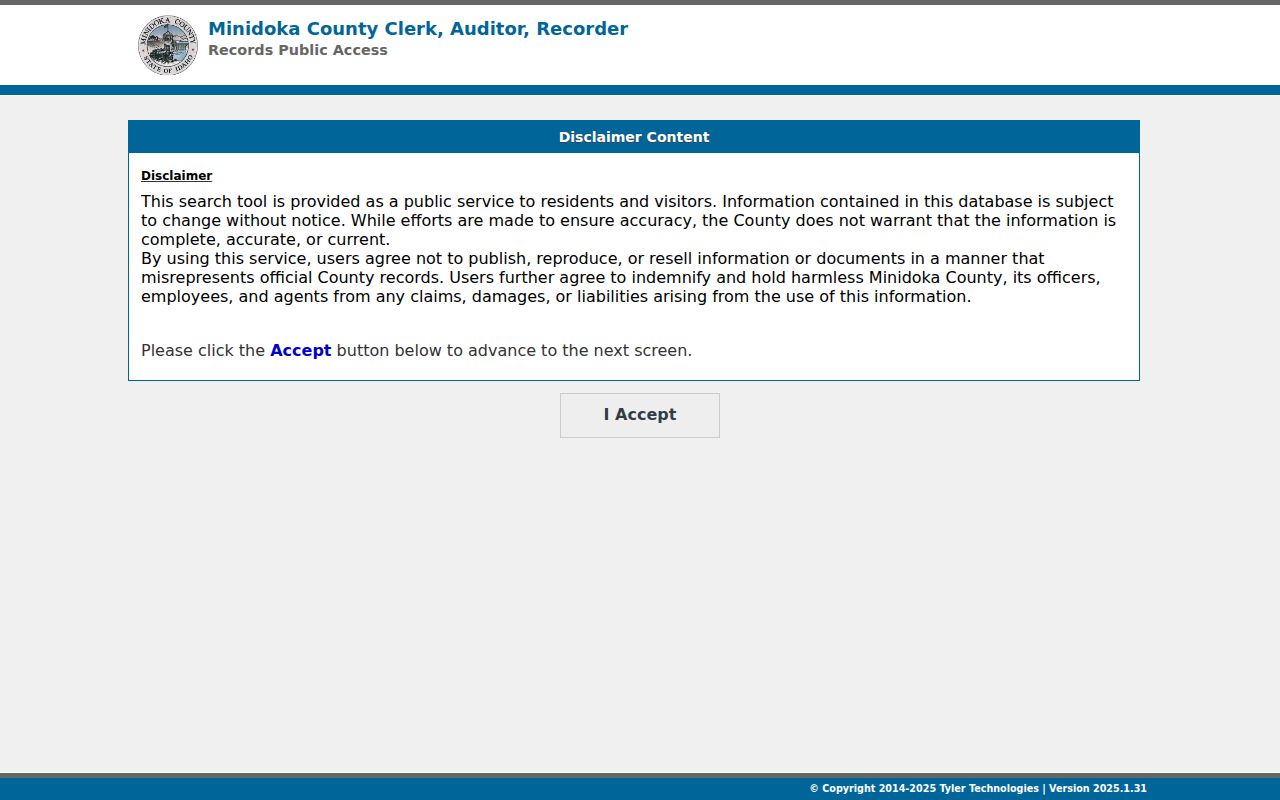
Think of the access notice as a map of the portal's edges. It is not a deed result. For the recorded instrument itself, the Minidoka County Recorder remains the stop that matters.
Follow Minidoka County Deeds by Party
Party role is the usual way deed records get traced. Find the most recent deed you can. Then hold the land description steady and let the names change around it. That constant legal description is what keeps a Minidoka County chain together. A GIS deed-reference field can supply a useful instrument clue. Carry that clue straight to the Recorder. The map slot is a pointer, never the deed itself.
- Identify the current assessment-roll owner and the parcel's legal description.
- Find the deed on which that owner is the grantee, then record its instrument number or book and page.
- Read the grantor's name and search for the deed on which that party received the same land.
- Repeat while matching the legal description, and move to office books or archival sources when the portal stops.
Deed-index vocabulary
- Grantor
- The party conveying the stated interest.
- Grantee
- The party receiving that interest.
- Chain of title
- The linked sequence of instruments associated with the same land.
- Book/page or instrument number
- A reference used to retrieve the recorded document.
Minidoka County Deeds Follow the Land
Names alone invite false matches. A Rupert or Heyburn deed may speak in townsite, addition, lot, and block language. Rural and Paul-area property records lean on township, range, section, tax-lot, railroad, and government-lot terms. Match the legal description from one transfer to the next. Note any split, combination, amended plat, or easement reference along the way.
Heyburn's earlier name, Riverton, shows how layered the history can get. Blue River Estates Phase 3 points back to earlier phases. Easements and vacated parts of Lincoln Boulevard appear there as well. Search only the modern street name. You may miss the recorded vocabulary that actually ties the land together.
Bridge Older Minidoka County Deed Records
Minidoka County's online deed index publishes no start year. FamilySearch fills the gap. Its catalog lists a historical collection titled “Idaho, Minidoka County Records, 1913–1961,” which holds deeds alongside patent, probate, marriage, military, naturalization, and school-census material that helps tell same-named parties apart in an early property trail.
Access may require a login or a FamilySearch center visit. The FamilySearch catalog entry shows the collection and its stated run.
Treat the catalog as a bridge, then confirm the deed, book, page, or plat with the Recorder or the Idaho State Archives. The Archives' online catalog is incomplete. A focused research request may be needed.
Early Minidoka County Deed Records and Rupert
Rupert's townsite was developed in 1905 and incorporated in 1906. It was filed in Lincoln County in 1907. That came before Minidoka County existed in its current role. An early chain of deeds can therefore benefit from place variants. Try Rupert, Wellfirst, Wetfirst, Original Townsite, lot, block, and Lincoln County. That is a search clue only. It proves nothing about series placement. Ask the Recorder or Archives to verify the jurisdiction, date, and book. No authoritative source documents a Minidoka courthouse fire or a destroyed decade of deeds. So gaps deserve no fire story.
Minidoka County Deeds and Encumbrances
Deeds are only part of what the Minidoka County Recorder holds. The office also keeps mortgages, trust deeds, reconveyances, releases, and powers of attorney. Leases, judgments affecting title or possession, and water-right instruments may appear in the same deed records. Mechanic's liens, lis pendens, attachments, and certificates of sale can add context too. When a document points to an earlier filing, search that related instrument number as well.
Some jobs belong elsewhere. The county states plainly that it cannot perform UCC or lien searches. State UCC work goes to the Idaho Secretary of State. A complete lien or title review needs more than a name search. It must go beyond a name search requested from the county clerk. Remember that a tax-deed or sheriff-sale notice marks a dated step in a proceeding. It is not automatic proof of clear title today.
A 2020 tax-deed notice shows why. It listed parcel IDs, situs addresses, lot-and-block descriptions, prior-owner names, and opening bids. The parcels were in Rupert and Heyburn. Those details make strong search keys for Minidoka County property records. Still, the notice covered an auction process and certified no present chain. Carry the parcel number and legal description forward into later instruments.
Court records open another branch of the deed search. Minidoka County sits in Idaho's Fifth Judicial District. There, foreclosure, quiet-title, and probate matters run as case leads through iCourt. Full files stay with the court clerk under Idaho Court Administrative Rule 32. Reconcile any case caption or sale notice with later Recorder filings before trusting the outcome.
Prepare a Deed for the Minidoka Recorder
Recording follows a few firm rules. Documents are recorded in the order received. Each one needs a two-by-four-inch recording-label space. The Recorder requires the original or a court-certified copy. Related filings should cite the original instrument number. For a return by mail, bring a large enough self-addressed stamped envelope.
Corrections are not always small edits. Re-recording calls for the original and the prior recording information. It also calls for the correction reason near the title, and initials for minor changes. A material change needs a new signed and notarized instrument with a correction reference. Recording intake ends at 4:30 p.m. Even so, the office lists weekday hours through 5 p.m.
Fees depend on the instrument. Deeds, grants, and conveyances of 30 pages or less cost $15 under the schedule. Trust deeds and mortgages in that size band run $45. Reconveyances and mortgage releases cost $15. Powers of attorney are $25. Longer instruments add a per-page amount, and surveys and subdivision plats follow their own schedule.
Recording differs from ordering a copy. Filing means presenting the original or a court-certified copy to the Recorder. A researcher who only wants to read an existing deed in the Minidoka County deed records can order a plain copy instead. A certified copy is also an option. State your goal so staff know whether you are filing or retrieving.
Order a Minidoka County Deed Copy
The Clerk/Recorder sits at 715 G Street, P.O. Box 368, Rupert, and takes calls at 208-436-7180 extension 110. Copies of recorder documents cost $1 per page, with certification at $1 per document. Say what you want. You might examine the record, receive a plain copy, or obtain a certified copy. Include party names, the parcel or legal description, an approximate date, and an instrument or book/page reference.
If the online route stalls, the county public-record request form is the fallback. It supports mail, fax, email, and hand delivery to the proper custodian. It works best for a defined record request. Check the fee page before relying on a total for a long document. For broader strategy, the Minidoka County property lookup guide explains how to carry an address into the parcel and record systems.
The form asks whether inspection or copies are sought. It provides lines for the record description, date, contact details, and signature. A response can arrange examination or attach copies. It may state cost, request more time, or cite a legal basis for denial. Under the printed process, an appeal may be filed in the county's state district court within 180 days.
Recorded, not guaranteed. Minidoka County deed records show accepted filings, not a title opinion or assurance that no unrecorded interest exists.